As many people know, board games have been a part of human civilisation for a long time. History has told us that games played on boards have been a prominent source of enjoyment and intellectual development for around 4000 years. Over this course of time, games have gone through some major changes. Most of this could be because of advancing technologies, or popular culture, but the fact is still there and the premise has stayed the same. "Almost all board games are imitations of situations in real life." (1 p1) It's strange, as somewhere down the line, all games can somehow be linked to each other. I'll show some examples of that in the following:
'Senet' (or 'Senat') is often thought to be the oldest board game in the world. It has been found in Egyptian burials dating from around 3500 BC and also featured in the tomb of Merknera around 3300 BC. Though "the rules for Senat have not survived" (1 p162) it is thought to have been very similar to 'Backgammon', a very well-known game in today's society.
 |
| A beautifully crafted game of 'Senet'. |
Backgammon is a simple game combining a mixture of luck and skill. Each player starts with 15 checkers, which must be moved into the Home Board so that they can be removed from the board. The first player to remove all of their coloured checkers is declared the winner. The origins of Backgammon lead to back to possibly over 5000 years ago, starting with the Iranian game "Nard". Although it has been refined (and named Backgammon) since around the 17th Century, the basic play of Backgammon was enjoyed by the likes of the ancient Greeks and the Romans. Names from these eras range from the Roman "Ludus duodecim scriptorum" and "jeux de tables" in France. Still very popular today, Backgammon is played by millions of people all over the world, with online internet play, tournaments and even gambling purposes.
 |
| A virtual game of 'Backgammon', as seen in 42 All-Time Classics for the Nintendo DS. |
Another world-famous game that springs to mind is 'Ludo'. This could be called similar to the previously mentioned games, but it's definitely unique in it's own right. The basic premise of the game is to get your pieces from your home base to the middle of the board using die rolls, and this basic play has stuck with each version of the game that has been produced. Originally named 'Pachisi' and originating in ancient India (which in turn originated from another race-style board game named 'Ashte Kashte', also from India), it has undergone several transformations throughout the years, if only minor. Over in the States, the game 'Parcheesi' was copyrighted by the Selchow and Righter company in 1938 (2), though it is unknown exactly when the boards were commercially produced. Variations of the game have appeared in many different countries, including the German "Mensch ärgere dich nicht" which means "Man, don't get irritated". The game in question, Ludo, made it's way to England back in 1896 during the time of the British Raj and was patented. Ludo is essentially a simplified version of Pachisi, with a more commercial look to the board.
 |
| A traditional game of 'Ludo'. |
Now I finally look at what is probably the most well-known board game in the world, Monopoly. "More than 275 million games have been sold worldwide and it’s available in 111 countries, in 43 languages" (3) Monopoly is based (and named) around the idea of buying and dominating properties to gain the series' signature paper money to avoid bankruptcy. The initial concept of this type of play was first conceived "in 1904 (by) Elizabeth J. Magie, (a) fledgling game inventor from Virginia, (when she) patented a forty-space game board that included railroads, utilities and the treacherous corner "Go to Jail". She called her game "The Landlord's Game". Rents were collected on real estate of increasing value, the properties were nameless and contestants travelled clockwise along the board's square pathway" (4). Around three decades after Magie had patented her game and had it distributed for a fair few years, in 1935, a man by the name of Charles Darrow saw real commercial potential in the premise. With his vision and the Parker Brothers' marketing muscle, they teamed up to make the game we all recognise today. One of the main additions made to Darrow's concept was a mascot for the game, originally known as "Rich Uncle Pennybags", now renamed "Mr. Monopoly" due to it being the more popular and referred-to name. Over the years, many editions of the game have been released, including those based on famous places, movies or even cartoons and video-games. In recent years, an electronic money system has replaced the old paper method to aid quicker and less fiddly gameplay. Monopoly is still going strong, even today, being released in new ways all the time. People can now play in almost any way they choose, with iPhone Apps, home console games, and as always, the traditional method of a board, die, paper money and the iconic tokens.
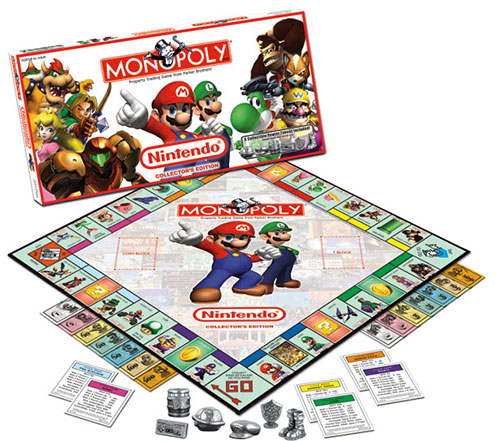 |
| A Nintendo edition of the classic game, 'Monopoly'. Proof that there's a version for almost everybody. |
So there's a brief history of the more popular board games. All of these games have many things in common: they're fun to play, create tension and provide an escape from reality. In my opinion, if a game doesn't have any of these things, then it's a bad game. Next in my research, I'm going to be looking at what makes a good game, and what makes a bad one.
(2) http://www.gamesmuseum.uwaterloo.ca/VirtualExhibits/Whitehill/parcheesi/index.html
(3) http://www.hasbro.com/monopoly/en_GB/discover/75-Years-Young.cfm
(4) Kennedy, R. and Waltzer, J. (2004)
Monopoly: The Story Behind the World's Best-Selling Game, Gibbs Smith.

No comments:
Post a Comment